Tennessee Radon Authority
Updated October 17, 2026

Lauderdale County Radon · Tennessee

Lauderdale County, TN radon No test events. No mandate in the verified codes.

Lauderdale County is EPA Zone 3, but the state dashboard recorded no county test events for 2022–2023. State enforcement covers rural areas and Halls, while Ripley runs its own code—and none of those paths requires radon-resistant construction.
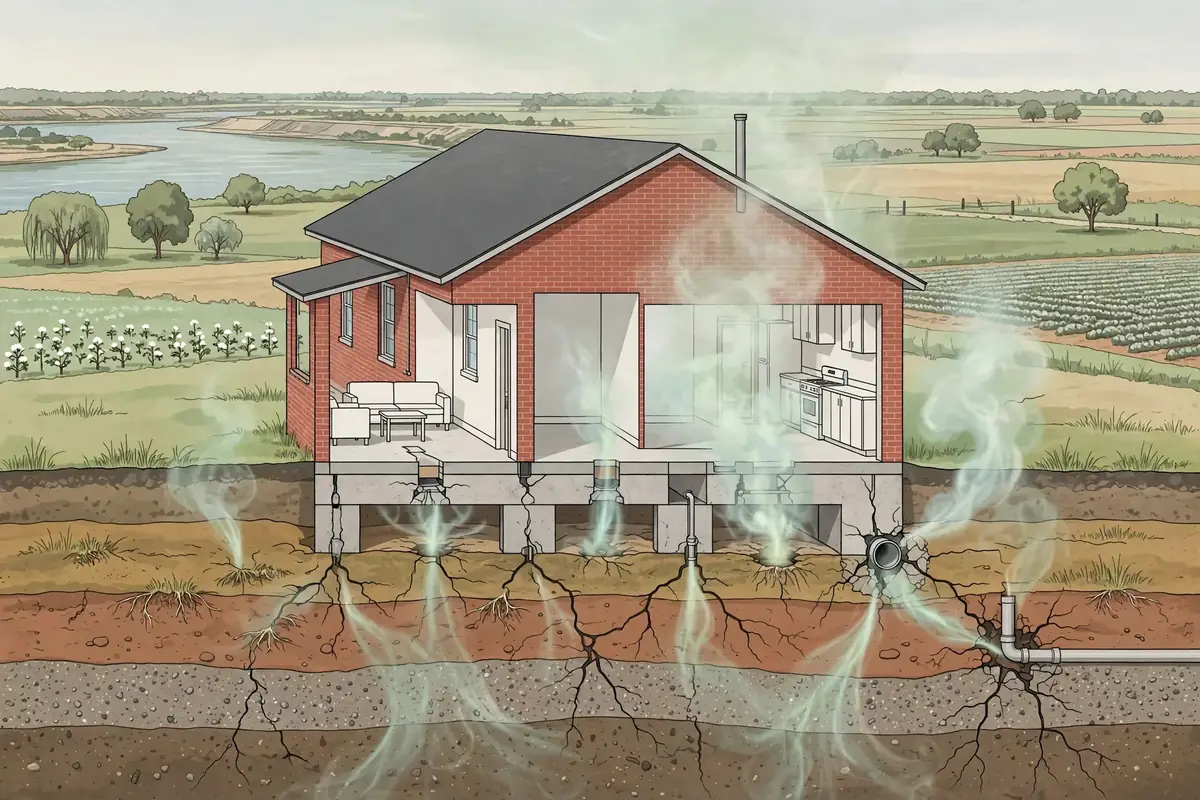
Illustrated cutaway of a rural West Tennessee brick home showing radon rising through the foundation
Radon can enter new and existing homes through soil-contact cracks and openings.

Radon in Lauderdale County, Tennessee: quick answers

EPA zone: Zone 3Region: West TennesseeState test data: No 2022–2023 state test records for this county

Is radon a problem in Lauderdale County, Tennessee?

It can be. Lauderdale County is in EPA Zone 3, the lowest predicted radon-potential category (below 2 pCi/L on average). Homes with high radon are still found in Zone 3, and the Tennessee Radon Program has found homes needing action in every Tennessee county, so test to know your home's level.

Do new homes in Lauderdale County, TN have to be built radon-resistant?

No. Unincorporated Lauderdale County and Halls follow the state's 2018 code without the radon appendix, and Ripley adopts Appendices M and N only. Henning wasn't confirmed. Local code details

How do I test my home for radon in Lauderdale County?

Order a free short-term kit from the Tennessee Radon Program online or by calling 1-800-232-1139. Place it on the lowest lived-in floor, about 3 feet off the floor, for 3 to 5 days, then mail it back right away. How to test your home

What radon level means I should fix my home?

EPA recommends fixing your home if radon is 4 pCi/L or higher, and considering a fix between 2 and 4 pCi/L. Confirm a high short-term result with a second test first. What your result means

Who can test or fix radon in Lauderdale County?

Tennessee doesn't license radon professionals, so look for NRPP or NRSB certification. Search both national directories by ZIP code; certified professionals often serve Lauderdale County from nearby cities. How to choose a radon professional

The bottom line

No data is not the same as no radon.

EPA places Lauderdale County in Zone 3, where predicted average indoor radon is below 2 pCi/L. Yet the Tennessee dashboard had no recorded county events in its 2022–2023 dataset. That blank tells us almost nothing about the next house.

EPA zone guidance ↗

Zone 3

EPA radon potential

Low predicted potential, below 2 pCi/L on average. Elevated homes can still occur.

0

State test events shown

The Lauderdale tooltip displayed “No Events” for 2022–2023 on two loads.

0

Certified pros based in-county

No NRPP- or NRSB-listed professional was found in Lauderdale County.

Risk profile

A low-zone county with almost no local evidence.

The EPA map estimates potential. The Tennessee dashboard summarizes submitted test events. Neither predicts a specific house.

Verified designation

Lauderdale County is EPA Radon Zone 3.

Zone 3 means predicted average indoor levels below 2 pCi/L. EPA cautions that elevated radon has been found in all three zones and recommends testing every home.

EPA Tennessee zone map ↗

No Events

The dashboard had no Lauderdale County test record.

On two separate loads checked October 16, 2026, the tooltip identified “County: Lauderdale” and showed “No Events.” Median and maximum fields were blank.

Open the Tennessee Radon Testing dashboard ↗

Read this as a data gap: the dashboard covers 2022–2023 submitted tests. “No Events” does not mean zero radon, zero risk, or that homes were tested and cleared.
Data limit

The lower charts are health-region aggregates.

Selecting Lauderdale did not turn the pre- and post-mitigation charts into county data. They remained grouped by health region, so they cannot support a Lauderdale County test count, mitigation count, or percentage above 4 pCi/L.

Building codes

Three clear paths. Two towns still unresolved.

Unincorporated Lauderdale County and Halls use state residential enforcement. Ripley runs its own program.

Unincorporated county · confirmed

State permits; 2018 IRC

  • Lauderdale County’s unincorporated areas are named on the state permit-required list.
  • The state adopts the 2018 IRC and Appendix Q only.
  • Appendix F, the radon appendix, is not adopted.
Ripley · confirmed

2018 IRC; Appendices M and N

  • Municipal Code §12-501 adopts the 2018 IRC.
  • The appendix list names M and N only—not Appendix F.
  • The code compilation reflects Change 1 through July 7, 2025.
Halls · confirmed path

State permits required

  • Halls appears on the state permit-required city list.
  • The state 2018 IRC path applies inside city limits.
  • The state’s radon appendix omission makes radon-resistant construction optional.
Henning · open

Current status not verified

  • Henning does not appear on the state permit-required city list.
  • The only MTAS code text found cites the 1982 Standard Building Code.
  • Ask the town or State Fire Marshal which path applies today.
Gates · open

Published code is outdated

  • Gates does not appear on the state permit-required city list.
  • The available code cites a 1997 Southern Building Code adopted in 1998.
  • Current enforcement and any appendix adoption remain unverified.
Countywide result

No verified radon mandate

  • No county or municipal radon-specific rule was found.
  • Tennessee encourages, but does not require, school radon testing.
  • Henning and Gates still require direct confirmation.

For homebuyers

Put the radon test in the contract.

No Lauderdale County point-of-sale rule was found. Tennessee’s disclosure form advises a radon inspection contingency rather than requiring a current test.

Add radon to the inspection contingency.

Tennessee sellers do not have to perform a radon test. The standard disclosure guidance tells buyers to consider a radon inspection contingency.

Test new homes, too.

The state path serving rural Lauderdale County and Halls does not adopt the radon appendix, and Ripley omits it as well.

Ask which jurisdiction issued the permit.

Request the adopted IRC and appendix list. For Henning and Gates, do not rely on decades-old online code copies.

Use Tennessee’s free-kit program.

TDEC offers free kits to homeowners and radon guidance by phone at 1-800-232-1139.

Tennessee property disclosure guidance ↗ · Tennessee Radon Program ↗

How do I find a certified radon professional in Lauderdale County?

Tennessee doesn't license radon testers or mitigators, so national certification is the best way to check qualifications. The Tennessee Radon Program points residents to two directories: search them by ZIP code and widen the radius if nothing is listed nearby.

We don't recommend or rank companies. Before you hire, check the certification number in the directory yourself and ask for a follow-up test after any system is installed. Questions to ask a radon professional.

Answers in brief

Lauderdale County radon FAQ

Is Lauderdale County in a high-radon area?
EPA classifies Lauderdale County as Zone 3, indicating predicted average indoor radon below 2 pCi/L. Elevated homes can still occur in every zone, so only a test can determine a home’s level.
What did the Tennessee dashboard show?
On two checks on October 16, 2026, the tooltip identified Lauderdale County and displayed “No Events” for 2022–2023. Median and maximum fields were blank. This is a data gap, not proof of safety.
Is radon-resistant construction required?
Not in unincorporated Lauderdale County, Halls or Ripley under the verified code paths. The state adopts only Appendix Q, and Ripley adopts Appendices M and N. Henning and Gates remain unverified.
Should a new home be tested?
Yes. The verified jurisdictions do not require the 2018 IRC radon appendix. A test measures the home itself.
Are local certified testers available?
No NRPP- or NRSB-listed professional was based in Lauderdale County on October 16, 2026. The nearest NRPP listings were in Memphis, about 41 miles from Ripley.
Can I get a free test kit?
TDEC offers free radon test kits to Tennessee homeowners. The state program number in the research record is 1-800-232-1139.

Research trail

Primary and supporting sources

Dashboard, jurisdiction and professional-directory observations were checked October 16, 2026. Every unresolved record is identified above.

  1. TN State Fire Marshal residential permits — statewide program and 2018 IRC baseline.
  2. State permit-required jurisdiction list — unincorporated Lauderdale County and Halls.
  3. TN Rule 0780-02-23 — 2018 IRC and Appendix Q adoption.
  4. Ripley Municipal Code, Title 12 — 2018 IRC with Appendices M and N.
  5. Halls Title 12 — outdated text, not used for the current conclusion.
  6. Henning Title 4 — outdated text establishing the open question.
  7. Gates combined code — outdated 1998 adoption record.
  8. Tennessee Radon Testing dashboard — two Lauderdale tooltip observations.
  9. EPA Tennessee radon zone map.
  10. EPA zone map guidance — test every home regardless of zone.
  11. NRPP professional directory — Ripley, Dyersburg and Memphis snapshots.
  12. NRSB professional finder — Tennessee RMS/RMT snapshots.
  13. EPA qualified-provider guidance — NRPP and NRSB.
  14. State school-radon policy review — Tennessee categorized as encourage, not require.
  15. Tennessee property disclosure guidance — buyer radon contingency advisory.
  16. Tennessee Radon Program — free kits and technical guidance.